Navigating Complexity When Technology, Policy, and Markets Collide

Key Takeaways
Complex problems are rarely solved through a single intervention.
Systems thinking helps leaders identify how decisions in one area affect outcomes elsewhere.
Translation is a leadership skill that helps stakeholders with different incentives work toward a common outcome.
Sustainable change occurs when technology, economics, incentives, and behavior reinforce one another.
We weren't trying to make homes more energy efficient.
We were trying to change the entire residential energy market.
Efficient HVAC systems, insulation, windows, and construction practices that dramatically lower energy use already existed, yet adoption remained limited. The challenge wasn't technology — it was the system surrounding it.
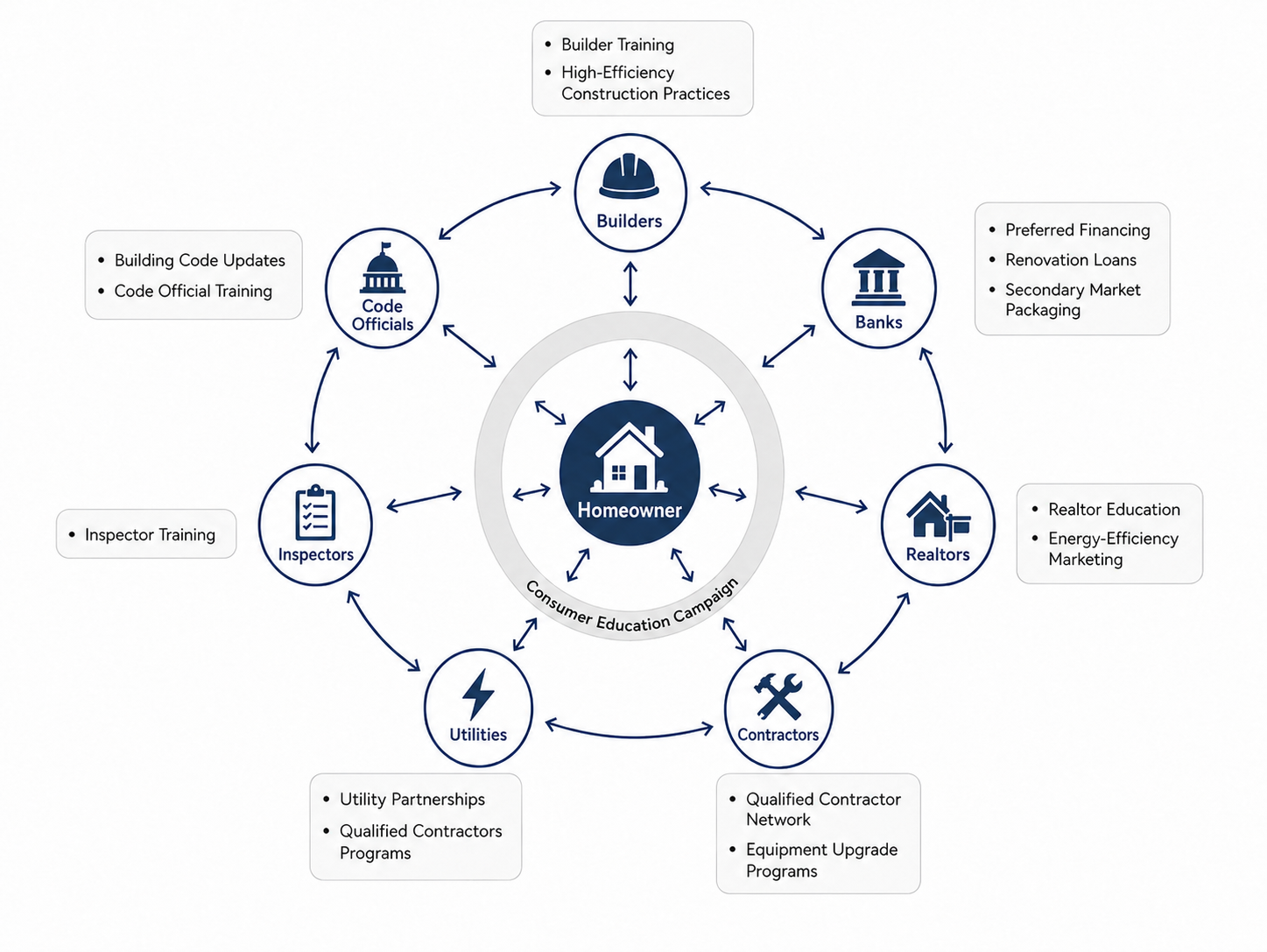
As part of a $12 million energy-efficiency initiative, my team and I mapped the residential housing market to understand how decisions were made and where influence existed. What emerged was not a single market, but an ecosystem of stakeholders whose decisions collectively shaped outcomes.
Every stakeholder saw a different problem
Builders, banks, homeowners, utilities, inspectors, contractors, and realtors all viewed the challenge through different incentives and priorities, and each was optimizing for the outcome that suited their purposes.
That observation changed how we approached the problem. Instead of asking how to convince homeowners to invest in more efficient homes, we considered how to align the entire system around making energy-efficient choices easier, more attractive, and more valuable for everyone involved.
The necessity of translation
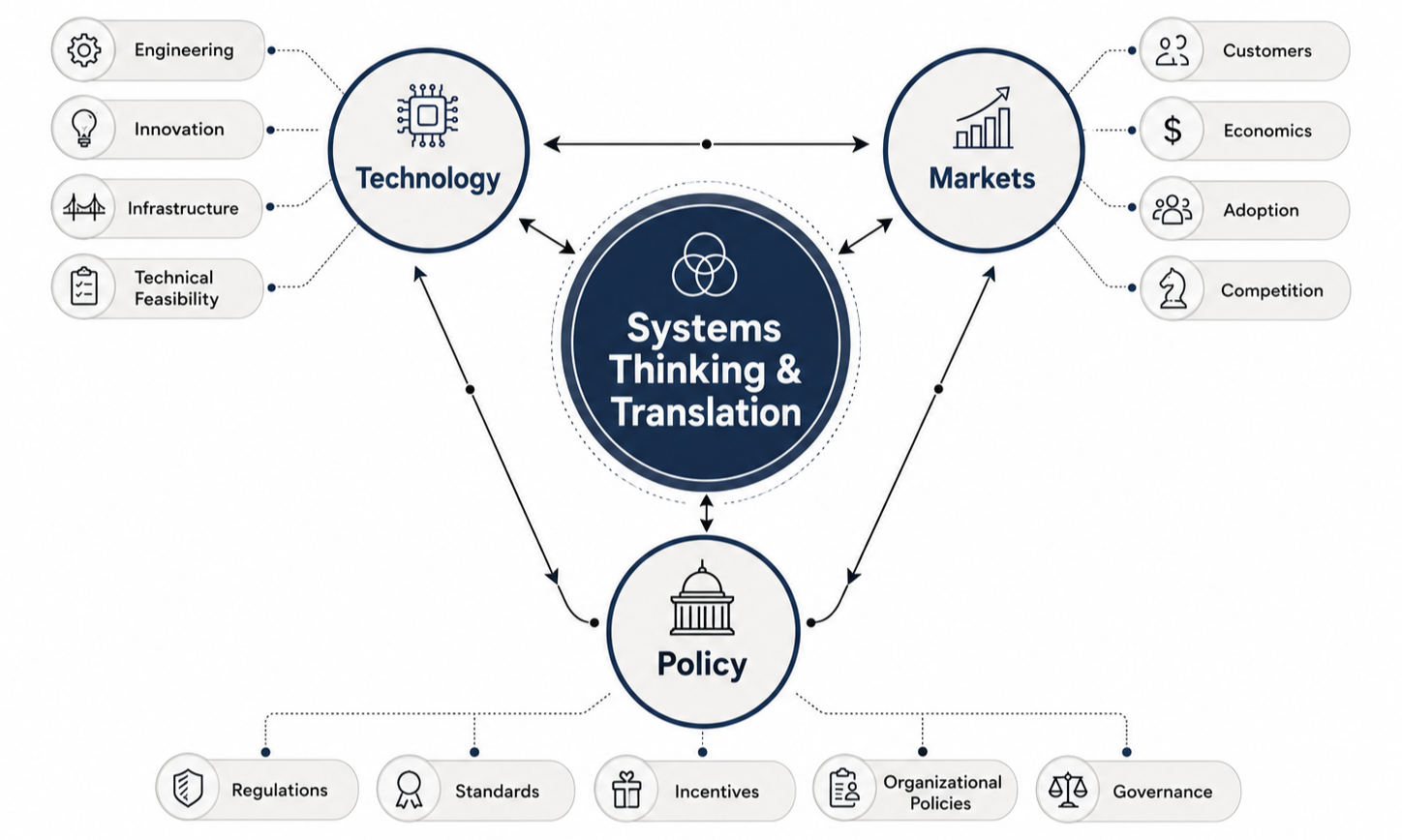
Throughout my career, I've found that the most difficult challenges exist at the boundaries between technology, markets, organizational priorities, and policy objectives.
That's why complex problems rarely yield to a single intervention; their barriers don't exist in one place.
Nor do interventions fail because stakeholders disagree. Interventions struggle to garner substantive results because stakeholders tackle different parts of the same problem — often without understanding how their individual actions affect the broader ecosystem.
Systems thinking and translation untangle the interdependencies that make challenges complex.
Systems thinking is the ability to see relationships that others experience as disconnected events. Translation is the ability to help one stakeholder understand how another stakeholder sees the problem.
Leaders who can see systems and translate across stakeholder groups identify opportunities and risks that remain hidden when viewing problems through a single functional lens.
As systems thinker Donella Meadows observed:
"We can't impose our will on a system. We can listen to what the system tells us, and discover how its properties and our values can work together."[1]
© 2026 Nicole Kaufman Dyess LLC
Designing for the ecosystem
Once we understood the system, the solution became about more than technology.
We trained builders, realtors, home inspectors, and code officials. We partnered with banks, utilities, contractors, and the regional property listing service (MLS). We strengthened building codes, created financing mechanisms, and launched a statewide consumer education campaign.
Every intervention reinforced the others, creating an ecosystem in which energy efficiency became the natural choice.
© 2026 Nicole Kaufman Dyess LLC
An enduring transformation
Over a two-year period, the percentage of high-efficiency home starts in the state increased from approximately one in five to nearly one in three. More than 13,000 existing homes were improved. Fifteen years later, several programs and partnerships established during the initiative remain active, continuing to make energy efficiency the easy choice.
The lessons I learned from this initiative extend far beyond housing.
Addressing complex problems require leaders who can see systems, understand competing incentives, and translate across stakeholders with different values, seeking different outcomes.
Sure, the technology matters.
The market matters, too.
The policy environment matters, also.
But lasting change often depends on something less obvious: the ability to connect these spheres.
Complex systems respond best when we stop treating isolated challenges and start understanding the interconnected ecosystem.
References
[1] Donella Meadows, Thinking in Systems: A Primer. Chelsea Green Publishing, 2008.